VVFA Modern | Artists | Hugh H. Breckenridge (American, 1870 - 1937)
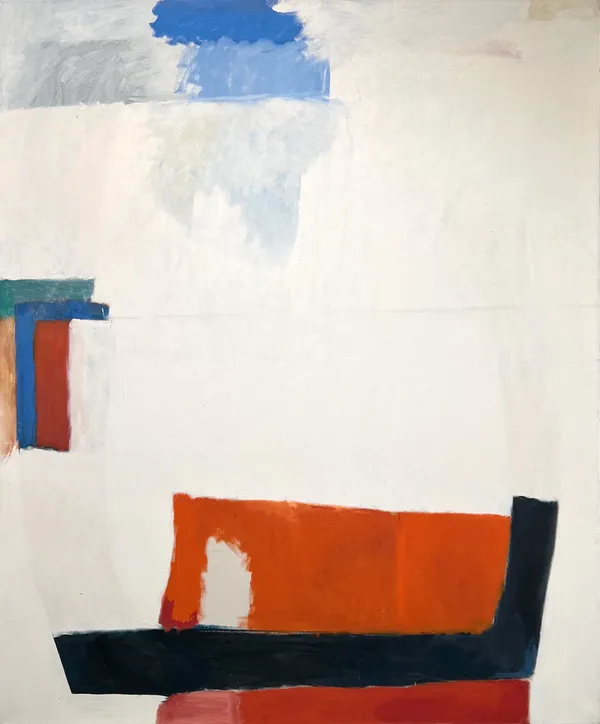
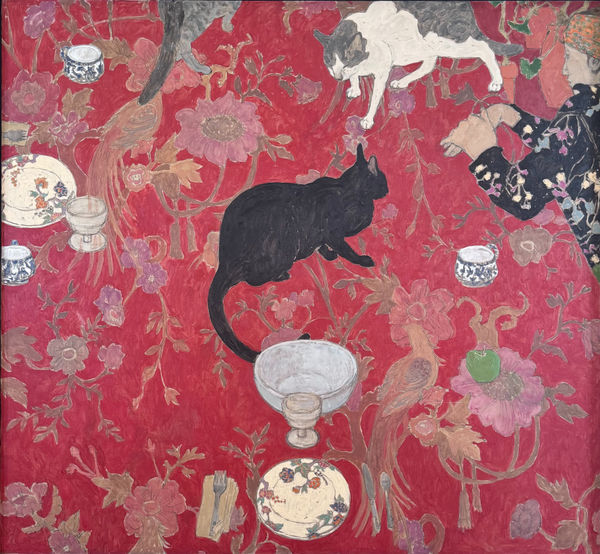
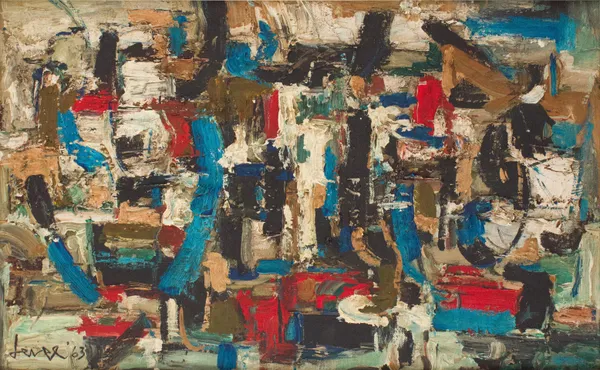
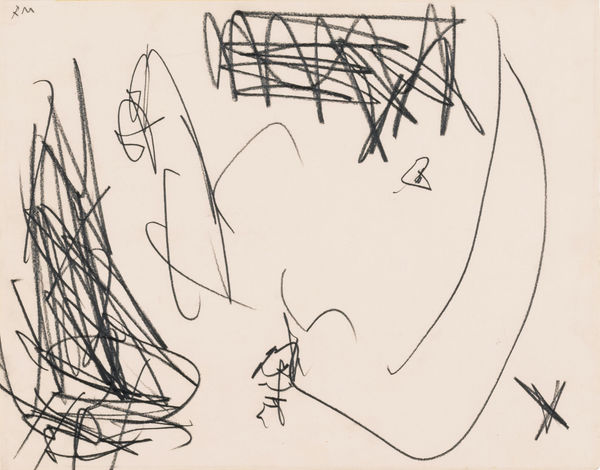
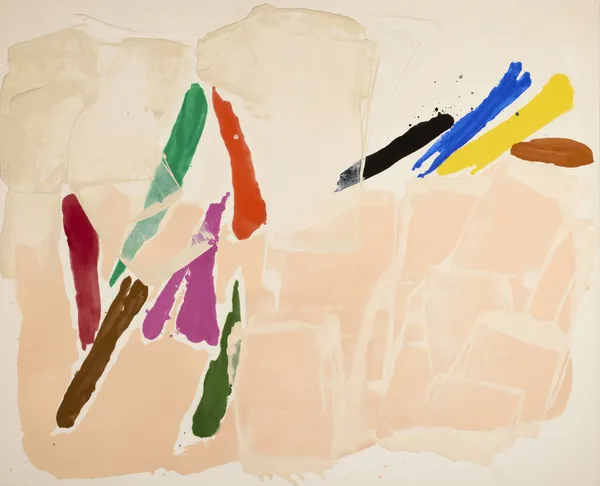
In Still Life #1A, Hugh Breckenridge created a very sophisticated analytic Cubist composition. While many artists of this era investigated cubist aesthetics, only a few – including Stuart Davis, Alfred Maurer, and Marsden Hartley – devoted themselves this deeply to it. With this sophisticated abstraction, Breckenridge ranks among these pioneering modernists.
Breckenridge probably painted Still Life #1A in the late 1920s; most of his purely abstract compositions date from 1917 to 1935, under the influence of Kandinsky's Abstractions and Improvisations. In his own non-representational work, Breckenridge, like Kandinsky, liberated color from its traditional descriptive function. As one writer astutely noted in 1934, in these abstractions he attempted to produce “an emotional reaction equivalent to that of music, not depending upon natural forms but derived from his reaction to nature and life. In this effort we find...invention and originality which, in the abstract production, is a vital necessity.” (1)
In Still Life #1A, Breckenridge laid pure pigments onto the canvas in thin strokes of paint that energize the canvas and produce a dynamic effect. The muted olives, browns, and greens contrast with the brighter whites, yellows, and reds. While shapes within the composition, such as the fruit in the lower portion of the canvas, suggest figures or objects, but the overall flattening and faceting obscures any explit references to the natural world. The low-toned palette, broken forms, and the elimination of perspectival illusion clearly reflects the influence of Pablo Picasso’s and George Braque’s innovations in analytic Cubism. Breckenridge, however, interprets the style in his own idiom by employing more saturated hues in reds, blues, and yellows.
During the nearly twenty years that Breckenridge worked in abstraction, he moved back and forth among different approaches to non-representational art. He argued that such freedom was an essential part of the creative process: “I see no reason why the painter should not have the same opportunity as the poet or musician to write one kind of verse today and another tomorrow...I don’t mean that [differnent styles of painting] are unrelated; they play always upon the same instrument--that of color and form as the result of color...” (2)
Breckenridge was one of Philadelphia's premiere modernist painters as well as one of the city’s most renowned and beloved teachers. Born in Leesburg, Virginia, he moved to the Philadelphia area around 1887 to study at the Pennsylvania Academy of the Fine Arts, an institution with which he would be affiliated with for the most of his life, first as a student, then as a teacher. In 1892 he received a scholarship that enabled him to pursue his dream of studying abroad. He went to Paris and enrolled in the Académie Julian under William Bouguereau. He also traveled through Europe with Walter Schofield, an Impressionist painter from Pennsylvania.
Like many artists at the turn of the last century, Breckenridge responded enthusiastically to the new and exciting changes in art that were rapidly taking place in Europe and America. He was particularly interested in the exploration of color and color theories. Upon his return from his first European sojourn he experimented with the impressionist technique and its investigations of color and light through landscapes, and figurative and portrait paintings. During his second trip overseas, in 1909, he became more aware of the latest experiments in painting. Throughout the rest of his career, Breckenridge moved freely among artistic styles, often working simultaneously as a Fauve, an Impressionist, a Cubist and an abstract artist. His work is in included in major collection of Amercian art, including the Los Angeles County Museum of Modern Art, the San Francisco Museum of Modern Art, the Pennsylvania Academy of the Fine Arts, and the New Orleans Museum of Art.
(1) Forward to Breckenridge retrospective exhibition catalogue, Pennsylvania Academy of the Fine Arts, 1938. Quoted in Margaret Vogel, The Paintings of Hugh H. Breckenridge, 1870-1927 (Dallas: Valley House Gallery, 1967), 20.
(2) Hugh H. Breckenridge quoted in Dorothy Grafly article in The North American (12 March 1922). Cited in The Paintings of Hugh H. Breckenridge (Dallas: Valley House Gallery, 1967), 19-20.
Breckenridge probably painted Still Life #1A in the late 1920s; most of his purely abstract compositions date from 1917 to 1935, under the influence of Kandinsky's Abstractions and Improvisations. In his own non-representational work, Breckenridge, like Kandinsky, liberated color from its traditional descriptive function. As one writer astutely noted in 1934, in these abstractions he attempted to produce “an emotional reaction equivalent to that of music, not depending upon natural forms but derived from his reaction to nature and life. In this effort we find...invention and originality which, in the abstract production, is a vital necessity.” (1)
In Still Life #1A, Breckenridge laid pure pigments onto the canvas in thin strokes of paint that energize the canvas and produce a dynamic effect. The muted olives, browns, and greens contrast with the brighter whites, yellows, and reds. While shapes within the composition, such as the fruit in the lower portion of the canvas, suggest figures or objects, but the overall flattening and faceting obscures any explit references to the natural world. The low-toned palette, broken forms, and the elimination of perspectival illusion clearly reflects the influence of Pablo Picasso’s and George Braque’s innovations in analytic Cubism. Breckenridge, however, interprets the style in his own idiom by employing more saturated hues in reds, blues, and yellows.
During the nearly twenty years that Breckenridge worked in abstraction, he moved back and forth among different approaches to non-representational art. He argued that such freedom was an essential part of the creative process: “I see no reason why the painter should not have the same opportunity as the poet or musician to write one kind of verse today and another tomorrow...I don’t mean that [differnent styles of painting] are unrelated; they play always upon the same instrument--that of color and form as the result of color...” (2)
Breckenridge was one of Philadelphia's premiere modernist painters as well as one of the city’s most renowned and beloved teachers. Born in Leesburg, Virginia, he moved to the Philadelphia area around 1887 to study at the Pennsylvania Academy of the Fine Arts, an institution with which he would be affiliated with for the most of his life, first as a student, then as a teacher. In 1892 he received a scholarship that enabled him to pursue his dream of studying abroad. He went to Paris and enrolled in the Académie Julian under William Bouguereau. He also traveled through Europe with Walter Schofield, an Impressionist painter from Pennsylvania.
Like many artists at the turn of the last century, Breckenridge responded enthusiastically to the new and exciting changes in art that were rapidly taking place in Europe and America. He was particularly interested in the exploration of color and color theories. Upon his return from his first European sojourn he experimented with the impressionist technique and its investigations of color and light through landscapes, and figurative and portrait paintings. During his second trip overseas, in 1909, he became more aware of the latest experiments in painting. Throughout the rest of his career, Breckenridge moved freely among artistic styles, often working simultaneously as a Fauve, an Impressionist, a Cubist and an abstract artist. His work is in included in major collection of Amercian art, including the Los Angeles County Museum of Modern Art, the San Francisco Museum of Modern Art, the Pennsylvania Academy of the Fine Arts, and the New Orleans Museum of Art.
(1) Forward to Breckenridge retrospective exhibition catalogue, Pennsylvania Academy of the Fine Arts, 1938. Quoted in Margaret Vogel, The Paintings of Hugh H. Breckenridge, 1870-1927 (Dallas: Valley House Gallery, 1967), 20.
(2) Hugh H. Breckenridge quoted in Dorothy Grafly article in The North American (12 March 1922). Cited in The Paintings of Hugh H. Breckenridge (Dallas: Valley House Gallery, 1967), 19-20.